
Dr. Smith, my pulmonologist, diagnosed my condition as idiopathic pulmonary fibrosis (IPF). She told me that it is an incurable, progressive disease. A word she did not use was ‘terminal’ but the words she did use, combined with her attitude and sympathy, told me that IPF is terminal, i.e. life ending. Generally a person is not considered as ‘terminal’ unless the life expectancy is less than six months. So I suppose I should say that I have a chronic, life-ending illness but I (apparently) am not yet terminally ill. But that doesn’t give me much comfort.
I hadn’t heard of IPF before Dr. Smith named it as my probable diagnosis. It was easy to get a basic understanding of the disease because it’s name tells what it is. Some diseases have names which offer no clue as to the nature of the illness, e.g. Hansen’s Disease or anthrax. Other disease names give you some indication of the symptoms of the disease, e.g. scarlet fever. But IPF is in that group of diseases where the name provides a good definition:
- idiopathic: of unknown origin or cause
- pulmonary: of or pertaining to the lungs
- fibrosis: buildup of fibrous connective (i.e. scar) tissue
So there we have it: a disease of unknown origin in which excess (unneeded) scar tissue builds up in the lungs. That’s all I know when I leave Dr. Smith’s office so when I return home I hit the computer and ask my friend Google to find me more information.
I skim a few sites which repeat what I already know: unknown origin, no cure, progressive. Then I learn some new things. IPF is included in a disease group called ILD or interstitial lung disease; there are more than 200 different disorders classified as ILDs. IPF is considered a rare disease. “Currently, more than 80,000 adults in the United States have IPF, and more than 30,000 new cases are diagnosed each year.”1 80,000 adults is not enough to populate even a small city. It is only about 3 ten-thousandths (or .03 percent) of the US population (more than 300 million).
The body builds scar (fibrous) tissue as part of the healing process. Fibrous tissue is different from the normal tissue — that’s why scars on the skin are so visible. The fibrous tissue looks different and has a different structure and different properties. In IPF fibrous tissue is applied to the the lung tissue even where it isn’t needed. It’s as though the body has been fooled into thinking that the whole lung has been damaged and needs to be repaired with scar tissue. The fibrous tissue has two effects in the lungs. First, because it isn’t normal lung tissue, it hinders the movement of oxygen from air into the blood stream. Second, because it is less flexible than normal lung tissue, it causes the lungs to be stiffer so they don’t expand to the same extent as healthy lungs. The stiff fibrous tissue causes the lungs to make a characteristic sound like Velcro being pulled apart. One can listen to the lung sounds at the Insights in IPF web site.
Several of the items I find just repeat the above information but then I encounter a journal article which stops me cold when I read the second sentence of the opening summary: “The median survival of patients with IPF is only 2 to 3 years” from diagnosis.2 Two to three years? Two to three years! That is not nearly enough time to finish living. The fibrosis was first noted on a CT scan in April 2015 and the radiologist suggested the diagnosis at that time. That was a little over a year ago, so if that counts as my time of diagnosis then my expectancy is a bit less than two years. I sit stunned and stare at the computer screen. I read and re-read the sentence which is not just a grammatical construction but is also a sentence — my life sentence. The article does note that some patients live “much longer”. However, since the statistic is the median, that also means that as many patients don’t live nearly that long. I may not be terminally ill yet, but the odds are that I soon will be.
This is difficult news. It is harsh. A cold hand has grasped my vital organs and is squeezing. I’m in a state of mild shock for some time. I’m numb to my surroundings as I try to grasp this information and assimilate it. It is all I think about for a couple of hours, and then is the main thing I think of until going to bed. My mind turns to something else for a while but is brought back to the statistic — two to three years from diagnosis. I have clear memories of two to three years ago — it wasn’t that far in the past — and two to three years in the future seems far too brief. And the time may be less; it could be more but it may be less. In bed the statistic fills my thoughts again, and I toss and turn until I finally succumb to a fitful asleep. There is no rest or comfort here.
Footnotes
1. Idiopathic Pulmonary Fibrosis, Cleveland Clinic.
2. Brett Ley, Harold R. Collard and Talmadge E. King Jr., Clinical Course and Prediction of Survival in Idiopathic Pulmonary Fibrosis, American Journal of Respiratory and Critical Care Medicine, Vol. 183, No. 4 (Feb 15, 2011).
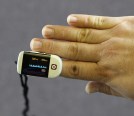 The pulse oximeter is an interesting little device. I’ve seen them before as they are widely used in hospitals and doctor offices but I’m still amazed by this bit of technology. It is simple and complex. It clips on the finger. A light shines through the fingertip and a sensor on the other side of the finger measures the light. The device indirectly measures the oxygen saturation of hemoglobin in the blood. A microprocessor determines the percentage of hemoglobin molecules which have bound oxygen. And it does this by measuring the small change in a beam of light. Amazing. And much less painful than having a needle suck into an artery to obtain a blood sample — the other (and more accurate) way to determine oxygen saturation.
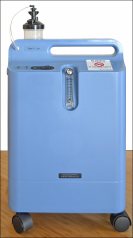 The supplemental oxygen order was processed and today the DME company arrives. The primary piece of equipment is a home oxygen concentrator. This device draws in air from the room, extracts most of the nitrogen (the earth’s atmosphere is about 78% nitrogen and 21% oxygen) leaving “air” with a high concentration (90 to 95%) of oxygen for breathing. The mostly-oxygen air is sent through a tube which connects to a nasal cannula. I have forty-five feet of tubing which is sufficient to allow me go to any place in my house or out on the front or back porch. The cannula has two prongs which are inserted into the nostrils. It feels odd when I first put the cannula in place. “You’ll get used to it,” the technician tells me. He shows me how to adjust the flow on the concentrator and explains the function of the switch and indicator lights. The oxygen passes through a bottle of water to add humidity before going out through the tubing. Water (distilled — no other kind) has to be added to the bottle about every other day. Otherwise there’s not much for the user to do: turn the machine on and clean the exterior from time to time is pretty much it.
 Egressing