
2016.04.11: Starting Supplemental O2

Today the durable medical equipment (DME) company delivered an oxygen concentrator, several small tanks, and a large emergency tank. Today I begin using supplemental oxygen.

At my last clinic visit I told Dr. Smith that when resting I feel okay but when I go up stairs or walk to the park at the end of the block I start breathing very heavily. She called the nurse who administered a standard six minute walk test. This is a simple test. The nurse puts a pulse oximeter on my finger, looks at her watch, and says, “Let’s start walking.” We walk at a brisk pace through the halls to the exterior wall of the building, turn around and head back. Then we do it again without stopping. Every twenty to thirty seconds she tells me to check the reading on the pulse oximeter.
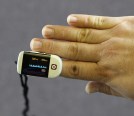
pulse-ox-1936588_640The pulse oximeter is an interesting little device. I’ve seen them before as they are widely used in hospitals and doctor offices but I’m still amazed by this bit of technology. It is simple and complex. It clips on the finger. A light shines through the fingertip and a sensor on the other side of the finger measures the light. The device indirectly measures the oxygen saturation of hemoglobin in the blood. A microprocessor determines the percentage of hemoglobin molecules which have bound oxygen. And it does this by measuring the small change in a beam of light. Amazing. And much less painful than having a needle suck into an artery to obtain a blood sample — the other (and more accurate) way to determine oxygen saturation.

The pulse oximeter reads 96 when we begin walking — an at-rest reading for a healthy person would be 98 or 99 so I begin below the norm. We walk and the reading drops: 94, 92, 91. We pass by Dr. Smith who asks, “How’s it going?” “He’s going to be on oxygen,” the nurse replies, “The reading is going down quickly.” It is dropping more slowly but continues to decline: 90, 89, 88. I’m breathing heavily when the nurse says to stop. It’s not yet six minutes and I’ve hit the point which indicates that supplemental oxygen is needed. I want to sit down but there’s no chair there. “Just breathe deeply and slowly, and you’ll recover soon,” the nurse tells me. She’s right and before long I feel like I can walk back to the exam room.

Dr. Smith is waiting. “Was it hard?” she asks. “Harder than I expected,” I tell her. She’s written a prescription for oxygen at two liters per minute (O2 at 2 lpm). She says I probably won’t need it when I’m sitting reading or watching TV but to make sure I use it when walking or engaging in other activity. She also tells me to check my O2 saturation from time to time, especially when active, to make sure I’m getting the oxygen my body needs. “Try to keep it above 95,” she instructs.

Philips_Respironics_Oxygen_Concentrator._Photo_taken_by_me_on_April_24th,_2012The supplemental oxygen order was processed and today the DME company arrives. The primary piece of equipment is a home oxygen concentrator. This device draws in air from the room, extracts most of the nitrogen (the earth’s atmosphere is about 78% nitrogen and 21% oxygen) leaving “air” with a high concentration (90 to 95%) of oxygen for breathing. The mostly-oxygen air is sent through a tube which connects to a nasal cannula. I have forty-five feet of tubing which is sufficient to allow me go to any place in my house or out on the front or back porch. The cannula has two prongs which are inserted into the nostrils. It feels odd when I first put the cannula in place. “You’ll get used to it,” the technician tells me. He shows me how to adjust the flow on the concentrator and explains the function of the switch and indicator lights. The oxygen passes through a bottle of water to add humidity before going out through the tubing. Water (distilled — no other kind) has to be added to the bottle about every other day. Otherwise there’s not much for the user to do: turn the machine on and clean the exterior from time to time is pretty much it.

The technician shows me a large tank of oxygen for emergency use if the concentrator fails or if the electricity goes off (thus stopping the concentrator). He shows me the small portable tanks and takes me through hooking up the regulator, opening the valve on the tank, and setting the regulator. A carrying bag for the portable tank is included. The tank and regulator weigh about five pounds — not heavy but noticeable.

I now have a tether at home, fifty-five feet of plastic tubing tying me to a machine which provides what I need to function (almost) normally. When outside of the house I have a constant companion — a small green cylinder of vital gas. I am grateful that the supplemental oxygen should make me feel better and will reduce the shortness of breath. But I don’t like this very visible announcement of my disease, this evidence that my body is failing.

2016.04.04: It’s Definite

I’m sitting in the exam room, waiting. Waiting is one of the most pervasive of human experiences. We wait, and we wait for something, so waiting has an air of expectancy. We wait for many things, and what one is waiting for colors the experience. A father-to-be waits for the delivery of a baby; a student waits for the results of an exam; a driver waits for a traffic light to change from red to green. The father-to-be is joyously expectant and probably nervous. The student may dread seeing the test grade. The driver may be bored or antsy depending upon the nature of the trip.

diagnosisI’m waiting for the physician to enter the exam room. I expect the physician but the physician is just a messenger; what I’m really waiting for is a diagnosis.

I am nervous and feeling some dread because the diagnosis could be bad; but I’m also hopeful that it won’t be — that it will be something easily treated and that I’ll experience a return to health and normal activity.

Dr. Smith is a pulmonologist. I was referred to her by my primary care provider (PCP) and first saw her on February 19 of this year. (This visit is chronicled in an earlier post.) She examined me, ordered a high resolution CT scan (HRCT) and pulmonary function test (PFT), and referred me to a rheumatologist. I have the results from the rheumatologist (no disease or condition identified) and today Dr. Smith will tell me the results of the HRCT and PFT. These test results, along with the information she gathered previously, may lead to a diagnosis. I sincerely hope so; it’s been two years since I first sought medical attention for for my problems. It’s been a long road with many physicians, exams, blood tests, x-rays, and scans.

Dr. Smith enters the room after a shorter wait than I expected.
“Hello, Mr. Franklin. How are you today?”
“I’m nervous.” [slight grin] “How are you?”
“I’m doing well.”

She gives a slight pause with a slightly embarrassed look, as though she should not be feeling well.

She continues. “I have the results of the HRCT and PFT. The PFT shows that you have a definite decline in lung function. The HRCT has more information because it shows the lung tissue.”

Another short pause but no embarrassed look. Is this pause because she doesn’t want to continue? Is she considering what to say?

“The HRCT shows scarring in the lungs, as was reported in the CT scan last year. The HRCT shows more detail, and the scarring is clear.”

A little pause. The pauses are getting to me. I’m waiting, expecting a diagnosis, and the pauses draw out my waiting time and increase my anxiety.

She continues. “I’m sorry, but the HRCT clearly shows idiopathic pulmonary fibrosis (IPF).”

The pause this time is welcome. I need to get hold of this and try to get it solidly in my head before I can listen to whatever else Dr. Smith has to say.

And what she says needs to be heard but is hard to hear. “It’s a progressive disease. There’s no cure, and there’s very little treatment available.”

Another welcome pause. I probably have a “deer in the headlights look.” Or maybe a deer in the sights of a rifle, if the deer could see the rifle.

I look at her. “Last time you mentioned doing a lung biopsy. Should we …”

She shakes her head. “I don’t think a lung biopsy will give us any additional useful information. Let me show you the HRCT scan.” She turns her laptop around and clicks a few times. “Here’s the view of your lungs from the bottom up. See these lines? They are scar tissue. This pattern is called ‘honeycombing’. It is indicative of IPF and is definitive for a diagnosis. Your scan is textbook so I don’t think we need to do more tests; I think the diagnosis is certain. I’m sorry.”

She writes prescriptions for two medications which help my breathing, but she emphasizes that they do not treat IPF; they just help the remaining healthy lung tissue to function well. She says that later we will talk about two drugs which are available to treat IPF. “You need to think things over,” she says.

Yes, I do.

2016.03.16: The Rheumatologist

Dr. Smith referred me to a rheumatologist because she thinks it likely that I have a systemic disease and probably an autoimmune one. I arrive at the clinic about half an hour before my appointment. I had a long drive and didn’t want to be late so I left home early to allow ample time for the drive in case traffic hindered me. The waiting room is very small with fewer than twenty chairs. I check in and have a seat. I brought my iPod (as is my custom) and I try to listen to a podcast but I’m have trouble concentrating.

I don’t know much about autoimmune diseases. I know they are caused by the body’s immune system attacking cells which it shouldn’t attack. I think of it as a coup with the immune cells trying to overthrow the established organ regime. I know that rheumatoid arthritis and lupus are autoimmune diseases and that diabetes sometimes is. I don’t know much else but then I remember that I’ve also heard of sarcoidosis although my knowledge is no more than minimal.

Knowing so little about specific autoimmune diseases is good. When one doesn’t feel well and is searching for the cause, it’s too easy to see one’s symptoms in diseases. One reads about a disease and compares one’s mental notes with the symptom list. At first it’s okay: Yes, I have this one; no, not that one. But often one can fall into the trap of expanding one’s symptoms to fit the disease. (“Maybe I have that a little even though I hadn’t thought of it.”) Hypochondriasis is not required for symptom expansion: diagnosis desperation can bring it about. My health has declined significantly for more than two years, and I’m desperate to put a name to it so that I can get treatment. Not knowing about the autoimmune diseases is good as it keeps my thoughts in check and prevents me from self-diagnosing.

I am absorbed in my thoughts and it doesn’t seem long before my name is called and I’m conducted to the exam room. There’s a quick check of my vital signs and then I’m left to wait for the physician. Time to try to attempt to concentrate on the podcast again. I am unsuccessful.

male physicianThere’s a quick knock on the door and Dr. Bailey enters and introduces himself. He sits at the small desk. He is tall and broad shouldered; he looks almost comical at the too-small desk. He pulls a sheaf of rolled papers from the side pocket of his coat. He looks at them and then tells me that he wants to go over some things which are in the notes from my previous physician visits. With a pen in his hand poised to emend the papers, he starts asking me questions. He asks how long I’ve been ill and what my first symptom was. He asks what other symptoms I’ve had, and like Dr. Smith, he requests that I tell him everything no matter how minor or irrelevant it may seem to me. He makes frequent notes and asks many questions. He then moves to my family history asking all manner of questions about my relatives and their health or cause of death. Not surprisingly he is primarily interested in parents and siblings.

As Dr. Bailey works I notice that my records which he brought with him have been marked with a highlighter and have notes in the margins in blue ink — the pen he is using in the exam room is black ink. It is obvious this man has done his homework and is serious about determining the reason behind my problems. It is also clear that he is listening to me. I have had two physicians in a row (Dr. Smith and Dr. Bailey) who are taking my health problem seriously and are applying their knowledge and time in an attempt to find an answer.

After completing the history he does a physical exam. He listens to my lungs and tells me that he can definitely hear the rales or crackles indicative of pulmonary fibrosis. He spends a great deal of time examining my nail beds and apparently does not find what he expected. The rest of the physical exam seems almost cursory.

He returns to the desk chair and turns to me. “Rheumatologists primarily treat autoimmune diseases,” he starts. “Some autoimmune diseases cause pulmonary fibrosis and generally we can treat them somewhat effectively. When a pulmonologist uncovers fibrosis, the pulmonolgist hopes that it is autoimmune based because a treatment is probably be available and the patient’s symptoms can be controlled. However, most fibrosis is not autoimmune caused, and when it isn’t, it’s unlikely that it can be treated. Pulmonologists send us a patient because they hope that the disease is one we can treat. Unfortunately, I don’t think you have an autoimmune disease. Clearly you are very ill and have been for some time. I wish I had an answer for you as I know that there is some relief in getting a diagnosis. I will order some additional tests because there are a few things which I can’t entirely rule out. If the tests are negative then my nurse will call you with the results. If any of them are positive then my nurse will call you to make another appointment. I wish you good luck in learning the cause of your illness. Dr. Smith will have my report when you see her again. If she can’t give you an answer, then keep looking. You may have to see other specialists before learning the cause. I’m sorry that I can’t tell you anything more definite.”

I thank Dr. Bailey. I glance at my watch and see that he has spent at least 45 minutes with me. It’s very unusual for a physician to spend that much time examining and talking with me. As a matter of fact, it may be the first time. As he starts to go out the door, I say, “Dr. Bailey.” He turns and I continue, “I want to thank your for spending so much time with me, learning about my problems, and trying to determine the cause. I know you’re busy, and I really appreciate the time you’ve spent with me and the work you’ve done.” He looks at me almost quizzically, and then smiles and goes out. I suspect he is not used to being thanked by a first-time patient for whom he does not have good news. But I really am thankful for his dedication and consideration. He asked questions, he listened, and he sought answers. What more could one want? Other than a diagnosis, that is.

2016.02.19: Diagnosis, Maybe

daily-report-and-checklist-medical-diagnosis-210-smallShe listens to me. “You are definitely ill,” she says. I am relieved when she says this. For two years I’ve been searching; physicians haven’t found the cause, and sometimes it seems they think I’m malingering. Sometimes so do I. I don’t feel good, but I lack specific symptoms — it’s an overall feeling of sickness with great fatigue. Many times I’ve thought that perhaps I don’t have an illness, that I’m just run down. I’ve had mild depression and I’m not sure whether it’s a result or cause of my fatigue and sick feeling.

My primary care physician (PCP) has referred me to a pulmonologist because of an abnormal finding on a CT scan. This is my first meeting with Dr. Smith, the pulmonologist, and I’m very happy that she is courteous and is taking me seriously.

She listens to me, and I am grateful. Some physicians do not listen, or at least do not listen well. “Tell me everything which is wrong,” she says.

I tell her that I’m unsure which of the various complaints I have are relevant to whatever disease is causing this. She tells me to tell her everything, not to worry about whether it is important. She says that she will sort through my symptoms and the test results to determine what is relevant.

So I tell her everything. It actually isn’t a long list. My chief complaint is fatigue. I am tired most of the time. I sleep a lot and I’m still tired. When I’m not tired I do things — some computer work (how I earn money) or clean house or run errands. But I lack stamina and I tire quickly. I haven’t been able to work an eight-hour day in two to two-and-a-half years. I’m self-employed and work from home so I work for a while, rest or sleep, work for a while, rest or sleep. But even with (sometimes long) breaks I can’t work eight hours in a day. The fatigue is so overwhelming that at times I fall asleep while working at the computer. Watching TV or a movie is impossible because I fall asleep; I’m just too tired to stay awake.

I also feel sick; just a general overall feeling of not being well. I have a persistent dry cough. And I have pain my toes and fingers; it’s a nearly constant burning ache and feels as though it’s in the bones. Sometimes there are very sharp shooting pains in the bones. These don’t last long but they’re quite intense. I have a few other things which I mention but they are secondary to the fatigue, feeling ill, and bone pain.

“Do you get short of breath?” she asks. “No,” I answer. “I breathe hard when engaging in physical activity but after all, I’m 61 years old so that’s to be expected. I’ve never been short of breathe and gasping for air.” I will learn later that I am mistaken: What I have experienced is in fact shortness of breath and it isn’t just because of my age.

Another change which I don’t recognize at the time as a symptom is that my shoes are too tight. They weren’t too tight when I purchased them — in fact they were quite comfortable — but a year later they are tight and there isn’t enough room for my toes. It turns out that my toes are clubbing which causes them to take up more room and make the shoes tight. I had no idea of this at the time and didn’t mention it as a symptom to Dr. Smith. A month later I will learn that this symptom is significant.

Dr. Smith listens carefully, takes notes, and sometimes asks for clarification or additional information. Then she opens the lab results tab on her notebook computer. She starts telling me significant results from my blood tests over the past year. I’m aware of most of these. I worked in a hospital clinical laboratory while in graduate school so I’m familiar with the tests and I’ve reviewed the results as they were posted in my online medical record.

“Your white cell count has been elevated for some time but it hasn’t changed. The pattern doesn’t look like an infection and it isn’t high enough to indicate cancer. Your sed rate is quite elevated as is the C-reactive protein. Most other results are normal or nearly normal so there isn’t a clear indication of any specific disease. Your thyroid hormones and liver enzymes are normal so that rules out thyroid or liver dysfunction.” She changes to the radiology results tab. “The only clear indicator is the abnormal CT scan.”

Months earlier, in fact nearly eighteen months earlier, I experienced bouts of abdominal pain. One Friday night the pain was so bad that I went to the emergency room. The ER physician ordered a cat scan of the abdomen and the scan showed that I had gall stones although my symptoms were not typical for gall stone disease. The scan caught the lower portion of my lungs and the radiologist noted the presence of scarring in the lungs. This is what eventually got me to the pulmonologist. (I’ll give a fuller version of this story in a later post.)

Dr. Smith continues. “The scarring is indicative of pulmonary fibrosis, which is scar tissue in the lungs. It can be caused by many things and I can’t tell you much more until we run additional tests and do further studies. Right now I would state that you pulmonary fibrosis, probably idiopathic pulmonary fibrosis, but we need to investigate further. It may be something else. The underlying cause may be a disease which I don’t treat but I’ll set up referrals and order tests, and we’ll find out what it is.”

“Thank you,” I say. “Thank you.” And it is heartfelt. I’ve been trying to find out what’s wrong with me for two years and I’m not only physically tired from illness, I’m emotionally and mentally drained from pursuing and not getting an answer to the question of what’s wrong.

It is obvious how relieved I am and Dr. Smith says that she will keep me in her care until the cause of my illness is determined. “You have indicators of a long-term inflammatory disease and your illness is probably systemic. Most of the likely candidate illnesses would be treated by a rheumatologist and I’ll set up a referral for you. There are some tests which I know the rheumatologist will want so I’ll order those today and the results will be ready at the time of your appointment. I’m also going to order a high resolution cat scan (HRCT) of your lungs to see what that discloses and a pulmonary function test (PFT) to determine the extent of the damage to your lungs. Does that sound okay?”

Okay? It sounds great to me as this seems to be a plan which will produce results. I simply tell her that it is fine. Now I’ll get some blood drawn, get the HRCT and PFT, and wait for my visit to the rheumatologist.

The Journey Begins

Featured

In early 2016 I learned that I have idiopathic pulmonary fibrosis (IPF), an incurable and progressive lung disease. This blog chronicles my experiences as a person with a life-ending disease. Many people have similar stories, and I hope that this blog helps other people living with terminal or chronic diseases understand that they are not alone in what they experience. I also hope that the blog helps family members and friends of patients understand better what the patient experiences.

Note: I attempt to relate events and to portray people accurately in this blog; nothing is fictionalized unless expressly stated as such. However, all names are pseudonyms in order to respect people’s privacy. If you know the identity of anyone featured in this blog, please respect their privacy by not sharing that information with others. Thank you.