
Today the durable medical equipment (DME) company delivered an oxygen concentrator, several small tanks, and a large emergency tank. Today I begin using supplemental oxygen.
At my last clinic visit I told Dr. Smith that when resting I feel okay but when I go up stairs or walk to the park at the end of the block I start breathing very heavily. She called the nurse who administered a standard six minute walk test. This is a simple test. The nurse puts a pulse oximeter on my finger, looks at her watch, and says, “Let’s start walking.” We walk at a brisk pace through the halls to the exterior wall of the building, turn around and head back. Then we do it again without stopping. Every twenty to thirty seconds she tells me to check the reading on the pulse oximeter.
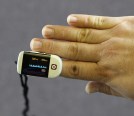 The pulse oximeter is an interesting little device. I’ve seen them before as they are widely used in hospitals and doctor offices but I’m still amazed by this bit of technology. It is simple and complex. It clips on the finger. A light shines through the fingertip and a sensor on the other side of the finger measures the light. The device indirectly measures the oxygen saturation of hemoglobin in the blood. A microprocessor determines the percentage of hemoglobin molecules which have bound oxygen. And it does this by measuring the small change in a beam of light. Amazing. And much less painful than having a needle suck into an artery to obtain a blood sample — the other (and more accurate) way to determine oxygen saturation.
The pulse oximeter reads 96 when we begin walking — an at-rest reading for a healthy person would be 98 or 99 so I begin below the norm. We walk and the reading drops: 94, 92, 91. We pass by Dr. Smith who asks, “How’s it going?” “He’s going to be on oxygen,” the nurse replies, “The reading is going down quickly.” It is dropping more slowly but continues to decline: 90, 89, 88. I’m breathing heavily when the nurse says to stop. It’s not yet six minutes and I’ve hit the point which indicates that supplemental oxygen is needed. I want to sit down but there’s no chair there. “Just breathe deeply and slowly, and you’ll recover soon,” the nurse tells me. She’s right and before long I feel like I can walk back to the exam room.
Dr. Smith is waiting. “Was it hard?” she asks. “Harder than I expected,” I tell her. She’s written a prescription for oxygen at two liters per minute (O2 at 2 lpm). She says I probably won’t need it when I’m sitting reading or watching TV but to make sure I use it when walking or engaging in other activity. She also tells me to check my O2 saturation from time to time, especially when active, to make sure I’m getting the oxygen my body needs. “Try to keep it above 95,” she instructs.
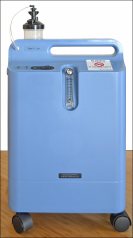 The supplemental oxygen order was processed and today the DME company arrives. The primary piece of equipment is a home oxygen concentrator. This device draws in air from the room, extracts most of the nitrogen (the earth’s atmosphere is about 78% nitrogen and 21% oxygen) leaving “air” with a high concentration (90 to 95%) of oxygen for breathing. The mostly-oxygen air is sent through a tube which connects to a nasal cannula. I have forty-five feet of tubing which is sufficient to allow me go to any place in my house or out on the front or back porch. The cannula has two prongs which are inserted into the nostrils. It feels odd when I first put the cannula in place. “You’ll get used to it,” the technician tells me. He shows me how to adjust the flow on the concentrator and explains the function of the switch and indicator lights. The oxygen passes through a bottle of water to add humidity before going out through the tubing. Water (distilled — no other kind) has to be added to the bottle about every other day. Otherwise there’s not much for the user to do: turn the machine on and clean the exterior from time to time is pretty much it.
The technician shows me a large tank of oxygen for emergency use if the concentrator fails or if the electricity goes off (thus stopping the concentrator). He shows me the small portable tanks and takes me through hooking up the regulator, opening the valve on the tank, and setting the regulator. A carrying bag for the portable tank is included. The tank and regulator weigh about five pounds — not heavy but noticeable.
I now have a tether at home, fifty-five feet of plastic tubing tying me to a machine which provides what I need to function (almost) normally. When outside of the house I have a constant companion — a small green cylinder of vital gas. I am grateful that the supplemental oxygen should make me feel better and will reduce the shortness of breath. But I don’t like this very visible announcement of my disease, this evidence that my body is failing.
 Egressing